
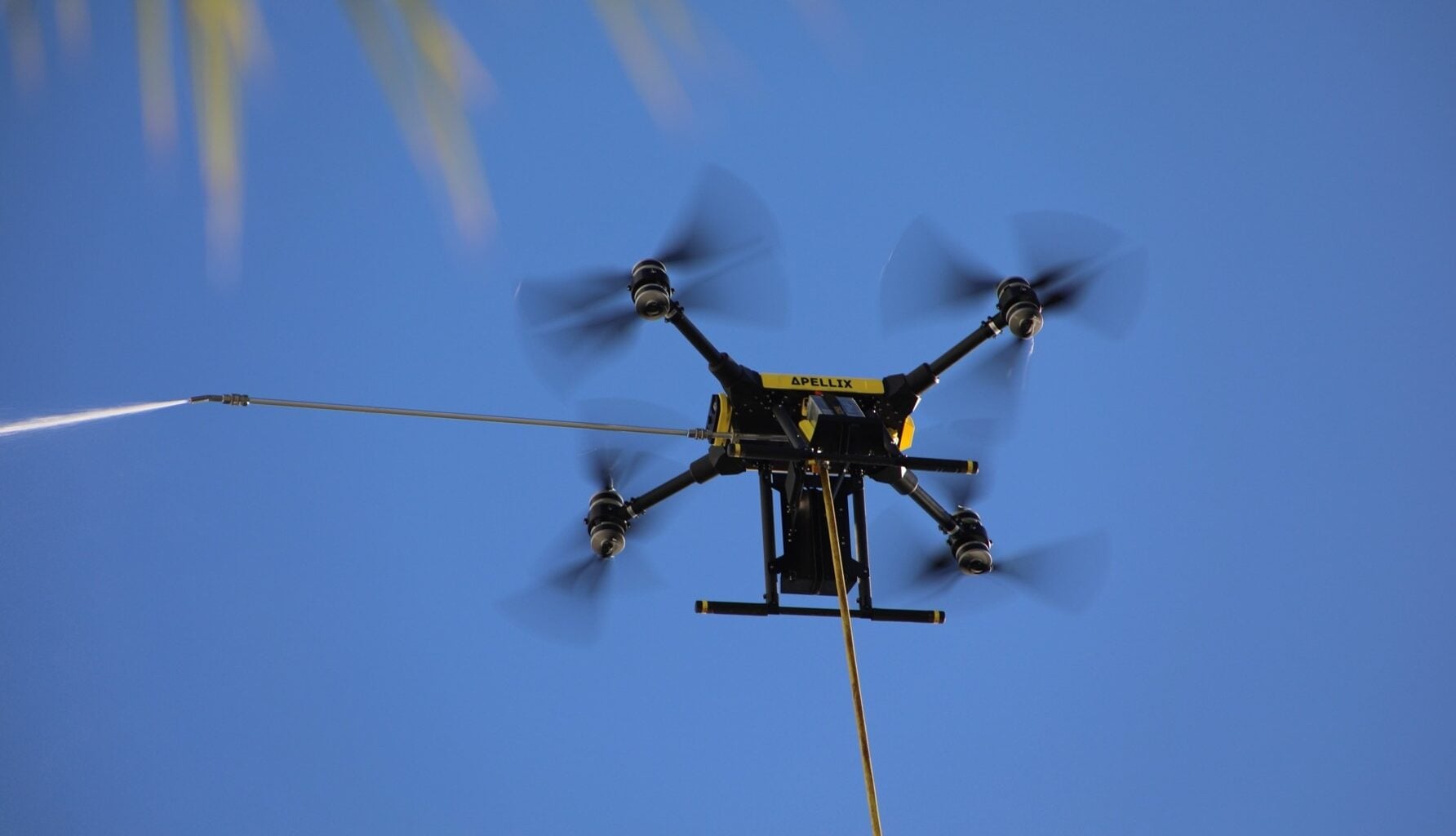

Every few years, a new technology doesn’t just improve an industry—it completely changes the economics behind it. Exterior cleaning is having that moment right now, and the technology doing the rewriting is the power washing drone.
Washing windows on a high-rise, soft-washing office windows, or taking mold off an above-ground storage tank has traditionally required scaffolding, boom lifts, rope-access crews, and the insurance premiums that come with putting human beings hundreds of feet in the air. Cleaning drones eliminate much of that complexity. The pilot stands on the ground. The setup takes minutes instead of days. And jobs that once took a week or more can be finished in a single afternoon.
For entrepreneurs, that combination – real demand, a dramatic cost-and-safety advantage, and a surprisingly low barrier to entry – makes drone cleaning one of the most credible startup opportunities in the drone economy today. Here’s how to evaluate it, and how to launch.
The short answer: To start a drone cleaning business in the U.S., you need an FAA Part 107 Remote Pilot Certificate, a purpose-built cleaning drone (roughly $45,000–$65,000), training, an LLC with commercial drone liability insurance, and standard ground equipment — a complete “business in a box” for about $75,000. No aviation background is required.
Take free expert-led courses and unlock access to tools, mentorship, networking, and Verizon grant opportunities for small businesses.


Why Is Drone Cleaning a Good Business to Start?
Plenty of drone business ideas sound exciting but collapse under competition. Aerial photography and real estate videography, for example, are saturated. The barrier to entry is relatively low, making it difficult to stand out. Drone cleaning is different for three reasons.
- You’re selling risk reduction. Building owners and facility managers don’t necessarily care about drones; they care about a clean building with no scaffolding permits, no site shutdowns, and zero fall risk. OSHA liability around work at height is a constant headache for property managers, and a service that removes humans from ladders and lifts is an a compelling value proposition.
- The speed advantage is enormous. Industry estimates put drone cleaning at up to 90% faster than scaffolding or rope access. There are documented cases of storage tanks that took 10 days to clean conventionally (most of it spent erecting and tearing down scaffolding) being finished by a single drone operator in an afternoon. One operator’s first tank job of that kind turned into a recurring contract worth millions, all flown on one drone.
- The equipment is a moat. A purpose-built cleaning drone runs roughly $45,000 – $65,000, which creates a meaningful barrier to entry for casual operators, but small enough that a determined founder can finance it like any other piece of commercial equipment. Once you add ground-based cleaning equipment you’re looking at a business in a box for $75,000. Compare that to the cost of a bucket truck or a standing scaffolding crew, and the math looks very different.
Demand is continuing to grow. Once one building in a market gets cleaned by drone, neighboring property managers notice. Some commercial cleaning bids now specifically request drone service, and incumbent window-cleaning companies have started buying drones simply to stop losing those bids.

What Do You Need to Start a Drone Cleaning Business?
The startup checklist is shorter than most service businesses:
- Get certified. In the U.S., any commercial drone operation requires an FAA Part 107 Remote Pilot Certificate. It’s a knowledge test, not a flight test; most people pass with a few weeks of self-study. No aviation background needed.
- Buy the right drone. This is one of the most important decisions you’ll make (more below). You cannot retrofit a consumer camera drone; cleaning drones are engineered to handle the recoil of high-PSI spray and the weight of a tethered water line.
- Get trained. You’re flying a spinning chainsaw next to windows. Choose a manufacturer whose training program matches your team size and budget, and don’t take a paying job until you’ve completed it.
- Set up the business properly. Form an LLC, separate your finances, and carry commercial drone liability insurance with coverage limits appropriate to the high-value structures you’ll work near. Many operators add hull coverage on the drone itself.
- Price Your Services and Find Customers. Drone cleaning is typically priced per square foot, per job, or as a day rate, with premiums for structures that are difficult or impossible to access conventionally. Your best early prospects: property managers, facilities directors, solar O&M companies, condo associations, and existing pressure-washing companies that want to subcontract their height work rather than turn it down.
How Do You Choose a Commercial Cleaning Drone?
A few criteria matter more than the spec sheet suggests:
- Regulatory compliance. As of late 2025, the FCC moved to restrict new foreign-made drones from the U.S. so only American-made drones are allowed to be bought and sold in America. Federal property and many state contracts also require NDAA-compliant aircraft. If government, municipal, or utility work is anywhere in your plan, an American-made, NDAA-compliant platform future-proofs the business.
- Weight and reach. The FAA caps small drones at 55 pounds, so a lighter airframe leaves more headroom for tether and payload, which translates directly into how high you can work.
- Autonomy. Hands-free cleaning modes lower the pilot skill barrier and speed up jobs, which matters when you’re training employees rather than flying everything yourself.
- Training and support. A complete kit with real onboarding beats a cheaper box you have to figure out alone.
Here’s how the major platforms compare:
Exterior Cleaning Drone Platforms: Contractor Comparison
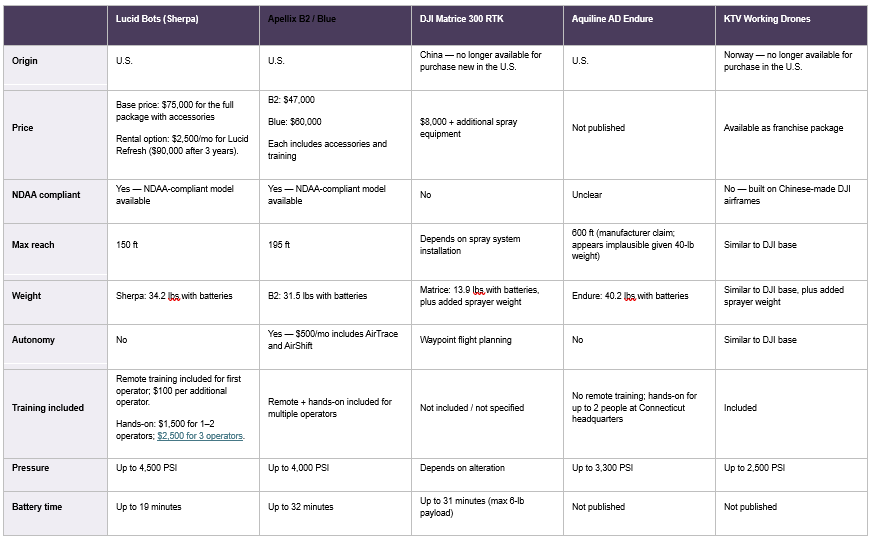
Specifications and pricing as published by manufacturers; subject to change. Confirm current figures directly with vendors before purchas
A note on the DJI option: the sticker price is tempting, but it’s no longer sold new in the U.S., isn’t NDAA compliant, requires you to engineer your own spray system, and comes with no training.
How Do You Win Drone Cleaning Jobs?
New operators often lead with the drone. Most clients aren’t buying the drone itself. They’re buying the results it delivers. They care that you can clean their building without shutting down the site, without scaffolding permits, without anyone leaving the ground — and faster than the incumbent vendor.
Sell the outcome: the church steeple no lift can reach, the building wall backing onto a retention pond, the solar array that’s been losing efficiency because nobody could clean it safely, the red tile roof that may crack if a roofer steps on a fragile tile with too much pressure. The drone is just how you deliver it.
The bottom line
Drone cleaning checks the boxes that most startup opportunities don’t: proven demand, a defensible cost advantage, a meaningful but financeable barrier to entry, and a sales pitch — safety and speed — that practically writes itself. The entrepreneurs succeeding in this space aren’t simply drone enthusiasts. They’re business owners using the right technology to solve real customer problems.
If you’ve been looking for a service business with real margins and a genuine moat, it might be time to look up.
Drone Cleaning Business FAQs
How much does it cost to start a drone cleaning business? A purpose-built cleaning drone costs roughly $45,000–$65,000. Adding ground-based pumps, hoses, and support equipment brings the total to about $75,000 — comparable to financing a single bucket truck.
Do you need a pilot’s license to fly a cleaning drone? In the U.S., commercial drone operation requires an FAA Part 107 Remote Pilot Certificate. It is a written knowledge test, not a flight test, and most people pass after a few weeks of self-study.
What can a cleaning drone clean? High-rise windows and facades, above-ground storage tanks, water towers, solar arrays, stadiums, roofs, and other elevated structures that would otherwise require scaffolding, lifts, or rope access. See real examples of cleaning drones at work on projects like the Seattle Space Needle and municipal water towers.
How fast is drone cleaning compared to scaffolding or rope access? Industry estimates put drone cleaning at up to 90% faster. Storage tank cleanings that took 10 days with scaffolding have been completed by a single drone operator in an afternoon.
Are cleaning drones NDAA compliant? Only some. U.S.-made platforms such as the Apellix Blue offer NDAA-compliant models, which are required for federal work and many state, municipal, and utility contracts.
Is training included when you buy a cleaning drone? It varies by manufacturer — see the comparison table above where training for 3 operators at Lucid’s facility in North Carolina costs $2,500. Some training, like Apellix Academy, include remote and hands-on operator training with every drone purchase; others charge per operator or provide none.