



Every startup asks potential customers for something. Sometimes it’s a purchase. Sometimes it’s an email address, a demo request, or simply a few more minutes of attention. People rarely give any of those things unless they feel confident about what they’re looking at.
Your homepage plays a big part in creating that confidence. Every headline, sentence, button, and proof point helps visitors decide whether your business understands their problem and offers a solution worth exploring.
When your messaging is clear, specific, and believable, people spend less time figuring out what you do and more time considering what comes next. That matters even more when your company doesn’t have a well-known name behind it.
This post shares practical ways to build trust through homepage messaging that gives visitors clear answers and solid reasons to keep moving forward.
Build Your Business. Get Grant Ready.
Take free expert-led courses and unlock access to tools, mentorship, networking, and Verizon grant opportunities for small businesses.
 We earn a commission if you make a purchase, at no additional cost to you.

Take free expert-led courses and unlock access to tools, mentorship, networking, and Verizon grant opportunities for small businesses.
Define Your Ideal User
A homepage that tries to speak to everyone ends up resonating with no one.
When your messaging stays broad, visitors have to do the work of figuring out whether your product applies to them. The truth is, most won’t bother.
The startups that convert well early on are usually the ones willing to get specific about who they’re talking to, even if that means excluding some visitors in the process.
- Start by naming your audience directly in your homepage copy. This doesn’t require a dedicated “Who it’s for” section, though that can work too. A well-placed phrase, like “built for independent consultants” or “designed for teams under 20”, tells the right visitor they’re in the right place within seconds. That recognition drives engagement more reliably than any generic value statement.
- From there, use language your ideal customer actually uses. Pull phrases from sales calls, support tickets, or customer reviews. If your audience describes their problem a certain way, mirror that language back to them. It signals that you understand their world without having to say so explicitly.
- Specificity also helps with positioning. A homepage that clearly defines its audience is harder to confuse with a competitor. It gives visitors a sharper reason to choose you over a broader alternative that technically does the same thing.
Clarify Your Value in One Sentence
Your homepage header carries more weight than any other line on your site.
Eye-tracking research shows visitors spend about 57% of their page time above the fold, which means whatever sits at the top either earns their attention or loses it. A vague headline burns that window fast.
The fix is simpler than most founders expect:
- Write one sentence that tells visitors exactly what you do, who you do it for, and what they get out of it.
- Cut the clever wordplay. Cut the abstract positioning.
- If someone unfamiliar with your industry reads your headline and immediately understands your offer, you’ve got it right. If they’d need to scroll or click to figure it out, rewrite it.
- Identify the single most important thing your product does for a customer. Then name it plainly.
- Pair it with a short line of microcopy below that adds a practical detail (for instance, clarifying the platform, the format, or the audience). Lead with whatever removes the most remaining doubt.
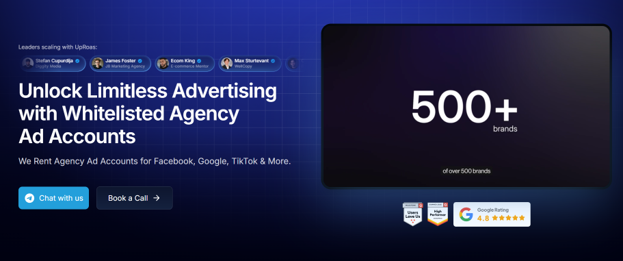
A clear example of how this looks can be seen by Uproas, a company that rents agency ad accounts for platforms like Meta, Google, and TikTok to advertisers who need elevated access and higher spending limits.
Their homepage header leads with the core benefit, and a short line directly beneath it names the specific platforms and the rental model. In turn, visitors understand the product, the mechanism, and the relevance to them without clicking a single link.
That’s the standard worth aiming for.
Source: uproas.io
Establish Credibility Immediately
Visitors arriving at your homepage carry a default level of skepticism, and for startups, that bar is higher than it is for established brands. They don’t know you yet, and generic claims like “trusted,” “experienced,” or “professional” don’t move the needle.
What does move it is specificity, like a named person, a verifiable credential, or a concrete track record that gives visitors something real to hold onto.
Here’s how to establish credibility right from the get-go:
- Lead with proof that’s hard to fake. Put a real name and face behind your product.
- Reference specific experience, such as years in the field, a professional background, or a relevant qualification.
- If you have partnerships with recognizable platforms or brands, display them early. Visitors process logos and credentials quickly, and familiar names borrow trust in a way that self-written copy can’t replicate.
- Also consider addressing competitor weaknesses directly. If your space has a credibility problem (and many do), naming it signals that you understand the landscape and that you’ve built your service specifically to solve it. That’s a more convincing trust signal than any badge.
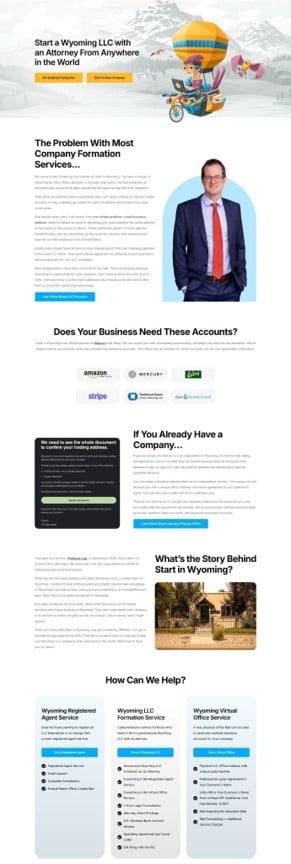
Start in Wyoming, a service that helps entrepreneurs and non-US residents form Wyoming LLCs and establish a legitimate US business presence, does this well.
Their homepage puts the founder front and center – a practicing Wyoming attorney with over a decade of legal experience. They call out that most competing services aren’t even based in Wyoming, and they back their claims with official partnerships with recognizable platforms like Mercury and Relay.
This removes hesitation at the exact moment when it’s most likely to cause a visitor to leave.
Source: startinwyoming.com
Let Customer Success Do the Talking
You can describe your product a hundred different ways, and none of them will hit as hard as a real customer saying it worked.
Research backs this up. 71% of marketers rely on customer success stories specifically to build trust and credibility with potential buyers.
On a startup homepage, where you’re asking strangers to take a chance on something unproven to them, that kind of social proof does a job your own copy can’t.
Here’s how to do it:
- Pull your strongest testimonials and pair each one with a face, a logo, and an outcome worth quoting.
- If you have video, use it. If you have case study data, link to it.
- Give visitors enough to feel convinced, and a clear path to read more if they want to.
- Keep the homepage versions short. A sentence or two from the customer, their name and role, and their company logo covers it.
- The full story should live one click away for anyone who needs more convincing.
The key is presentation. A wall of five-star ratings feels generic. A specific story with a named person, a recognizable company, and a concrete result feels real.
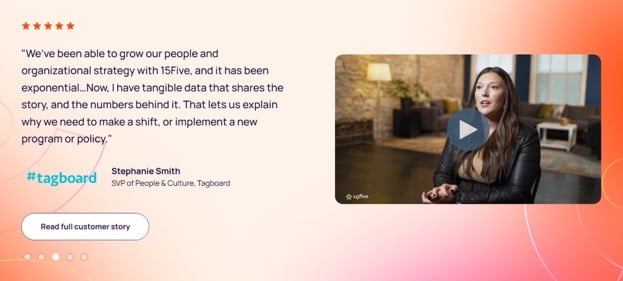
15Five, an AI-powered platform built to help companies track and improve how their teams perform, puts this into practice cleanly.
Their homepage surfaces excerpts from customer success stories, each combining a client quote, company logo, a short video from a company representative, and credentials. Visitors get a credible preview upfront, with full case studies one click away.
That’s enough detail to persuade without being overwhelming.
Source: 15five.com
Replace Claims with Evidence
Every startup homepage says something like “powerful,” “seamless,” or “best-in-class.” Visitors have read those words so many times they’ve stopped registering them.
The issue isn’t that founders are lying. It’s that unverifiable claims and hard evidence look identical at a glance, so readers treat both with the same skepticism. The ones that cut through lead with proof instead.
Here’s how you can do it:
- Audit your homepage copy for every adjective that describes your product’s quality.
- For each one, ask whether you have a number, a rating, or a third-party source that makes the same point more convincingly.
- Swap the adjective for the evidence. If you’ve been reviewed on platforms like Trustpilot, G2, or Capterra, display those ratings with badges.
- If you have usage data, like customers served, transactions processed, or countries reached, put those figures somewhere visible. Third-party validation carries more weight than self-reported claims because visitors didn’t read it on your site first.
- Keep the numbers current and honest. Inflated figures damage trust faster than no figures at all.
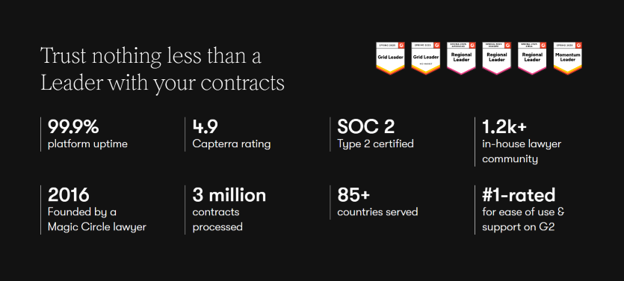
Juro, a toolkit that helps legal and business teams automate their contract workflows from creation to signature, handles this well.
Their homepage dedicates space to third-party ratings from platforms like G2 and Capterra, alongside operational metrics covering contracts processed and markets served. The badges confirm what independent reviewers think, and the numbers add context about scale.
Together, they replace vague quality claims with a concrete picture of a product that’s already working at volume across multiple markets.
Source: juro.com
Final Thoughts
Strong homepage messaging shapes how quickly a visitor understands your product and how confident they feel about moving forward.
Each section of your homepage plays a role in that process, from a clear value statement to evidence, trust signals, and customer stories. When these elements work together, visitors spend less time guessing and more time evaluating fit.
Small adjustments in language, structure, and supporting details often lead to noticeable changes in engagement and conversion.
Homepage trust builds step by step. Every line either reduces doubt or adds friction. So, keep refining until your message feels easy to understand and easy to believe.
Image by DC Studio on Magnific